|
In jewelry manufacturing, polishing has always been one of the most time-consuming stages. Even after a piece is carefully shaped, soldered, and refined, achieving a smooth, mirror-like surface often requires repeated manual work with polishing wheels, compounds, and hand tools. For small workshops and professional jewelers producing large quantities, this process can become a major limitation. Jewelry magnetic tumblers provide an effective solution by reducing labor requirements while maintaining consistent finishing quality.
A jewelry magnetic tumbler uses a rotating magnetic field to move tiny stainless steel pins inside a polishing container. These magnetic pins rapidly circulate around the jewelry pieces, reaching areas that are difficult to access with traditional polishing methods. Unlike hand polishing, which depends heavily on the operator’s skill and physical effort, magnetic finishing creates a controlled and repeatable process.
One of the biggest advantages of magnetic tumblers is their ability to shorten polishing cycles. Traditional hand polishing may require several separate steps, including rough polishing, smoothing, detailed edge treatment, and final buffing. Each stage requires careful attention, especially for complex designs containing small grooves, textured surfaces, or intricate patterns. A magnetic tumbler can handle many of these finishing tasks simultaneously, allowing jewelers to spend less time correcting minor surface imperfections.
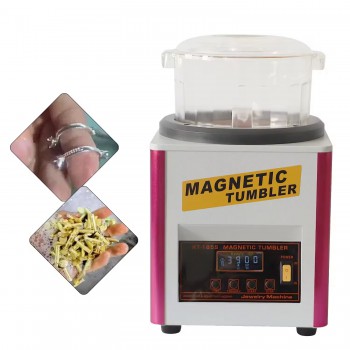
Another important benefit is improved efficiency when processing multiple pieces. A craftsman polishing rings, earrings, or small components individually must repeat the same movements hundreds of times. This repetitive work consumes valuable production hours and can cause fatigue. Magnetic tumblers allow several pieces to be processed together, making them especially useful for workshops that need consistent output without increasing labor costs.
The technology also improves polishing results in difficult areas. Traditional polishing tools often struggle with narrow spaces, chain links, detailed engraving, and the inner sections of small jewelry components. The extremely small magnetic pins used in these machines can reach these hidden areas and gently remove oxidation, fine scratches, and surface residue. This creates a more uniform finish that is difficult to achieve through manual methods alone.
For delicate jewelry, reducing excessive manual contact is another advantage. Aggressive polishing by hand can sometimes remove too much material, soften sharp design features, or create uneven surfaces. Magnetic tumbling provides a gentler finishing method because the polishing action is distributed across many tiny contact points rather than concentrated in one area.
The reduction of manual polishing time does not mean replacing craftsmanship. Instead, magnetic tumblers allow jewelers to focus their skills on creative tasks, design improvements, stone setting, and quality inspection. By transferring repetitive finishing work to a machine, artisans can dedicate more attention to the parts of jewelry production that require human judgment.
Modern jewelry businesses are also looking for ways to improve productivity while controlling costs. A magnetic tumbler requires less direct labor compared with traditional polishing methods, which can significantly improve workflow efficiency over time. For small studios, this means higher production capacity without immediately hiring additional workers.
Maintenance and operation are also relatively simple. Once the correct polishing solution, magnetic pins, speed, and processing time are selected, the machine can deliver stable results with minimal supervision. This makes it suitable not only for experienced manufacturers but also for workshops seeking to standardize their finishing procedures.
As jewelry designs continue to become more detailed and customized, the demand for efficient finishing solutions will continue to grow. Jewelry magnetic tumblers offer a practical way to reduce manual polishing time, improve surface quality, and create a smoother production process. By combining precision technology with traditional craftsmanship, these machines have become an important tool for modern jewelry makers.
https://www.jewelerstoolsmall.com/goods-1914.html
|



