Beeld- Tekstverantwoording; Foto's afkomstig van diverse bronnen; Beeldbank-Zeeuws Archief, Beeldbank-ZeelandNet, Beeldbank-Zeeuwse Bibliotheek Beeldbank-Wikipedia, Beeldbank-Google Openbare Sites, Collectie uit eigen archief. Tekst afkomstig van Wikipedia, en andere bronnen. in bewerkte of verkorte vorm Tekst uit eigen bron. Copyright; Eigenaren van foto's kunnen zich melden voor bronvermelding.
Educatief Internet-Magazine over historie van familie Klercq en duurzame mandenmakerscultuur
02-07-2011
Nelis' Dutch Village
Nelis' Dutch Village in Holland U.S.A.
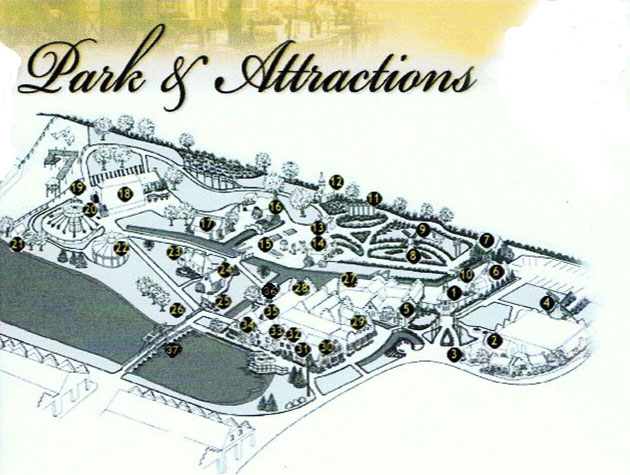
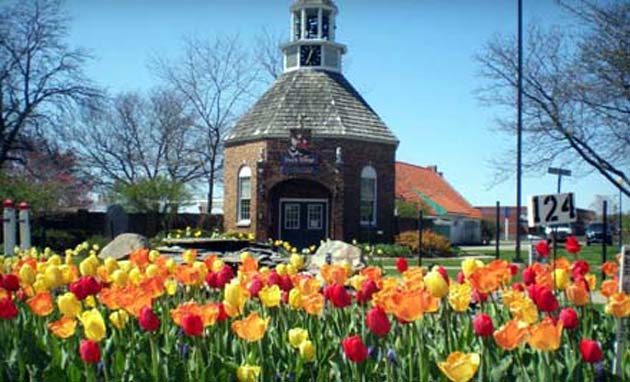
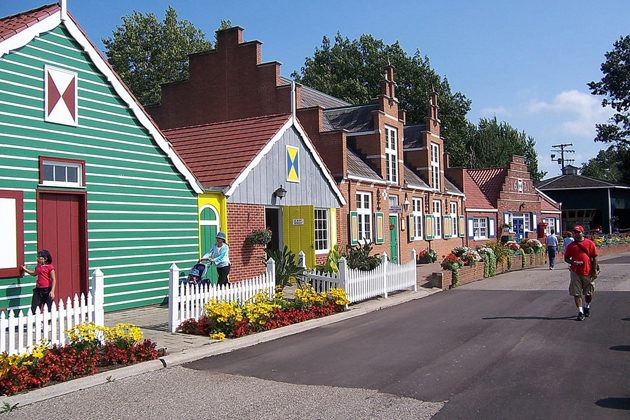
The story of Nelis' Dutch Village began in Beverwijk Nederland in 1910, when Frederick Nelis asked his son Harry, who was 17 years at the time, to travel to America and search for some rich farm land. World War I was just over the horizon, and times were tough all over Europe. The Nelis family was hoping to make a new start in the "land of opportunity." Plan of Nelis' Dutch Village in Holland Michigan. It includes buildings of authentic Dutch architecture, brick walkways, canals, gardens in special presentations depicting life in a typical village in the Netherlands. Your visit to this village, called Noordhuizen, brings history to life in a fun and friendly way. For attractions see site of Nelis' Dutch Village http://www.dutchvillage.com Entrance to the park, with Carillon Bell Tower
Young Harry departed on the s.s. Noordam in October of 1910, three weeks later he arrived at Ellis Island at the coast of New York, the mainport for most of the immigrants to the U.S.A. Following his father's instructions, he traveled to Misourri, purchased land and began to grow vegetables. In September of 1911, the rest of the Nelis' family, which included 11 brothers and sisters, ranging in age from 6 months to 16 years joined brother Harry.
Growing vegetables proved to be unprofitable, so the family moved to Chicago in search of more opportunities. After working at various jobs for a few years, they heard about a settlement in Holland Michigan and decided to visit the young Dutch community. Upon arriving, they were impressed with the beauty of the area and decided to purchase 80 acres of land just north of the town. A typical sight reminds to the province Noord Holland in the Netherlands.
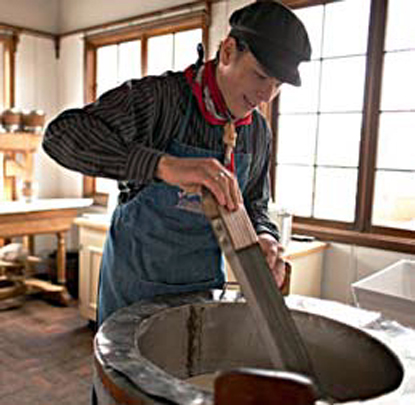
In the early years, the Nelis family grew vegetables to sell their products locally, also they made frequently trips to the Chicago markets. During the Depression when markets broke down, the family switched from horticulture to the nusery business. Not long after being in this trade, a cousin in the Netherlands asked Frederick to plant daffodills, since he had run out of planting space in the "old country." The making of deliscious Dutch cheese in a traditional way
That arragement dramatically changed life for the Nelis' family. They grew daffodills for a few years, but soon after they began to plant crops of tulips. By the late 1930's the tulip farm become a "hot spot," for tourist flocking to Holland for the new Tulip Time Festival, which grew out to an annually festival untill today, attracting millions of people. As time passed the tulip farm became increasingly popular and a large windmill and souvenir shop were added to the Nelis' market. Soon Holland souvenirs were as popular as the tulip bulbs. The making of deliscious Dutch cheese in a traditional way
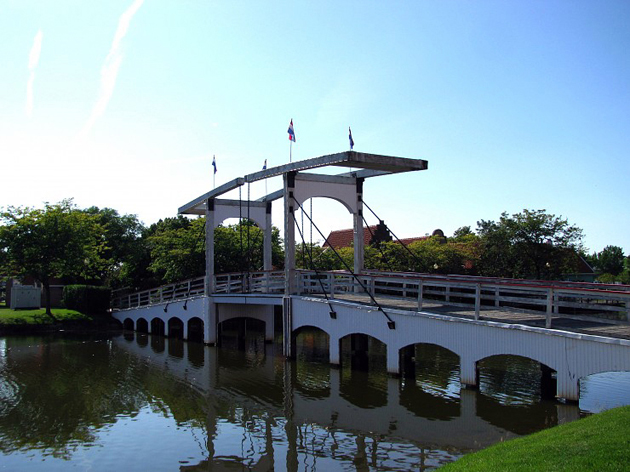
The present location of Nelis' Dutch Village was purchased in 1952, first it began as a retail for bulbs and souvenirs. The 40 acres were situated on a small two-lane road, which would later become US 31. At this time, Harry Sr.'s two sons, Fred and Harry Jr. joined the family company. Harry Jr. who had just returned from Naval duty in 1958 at the age of 24, and his older brother Fred recognised opportunities in building the first village houses, what would become the start of Nelis' Dutch Village, also called as Noordhuizen after the herritage of the family. The first year of the Village, many visitors travelling north stopped at the new Dutch market when they heard where tulip bulbs were to buy. A reproduction of "De Magere Brug van Amsterdam. (The Skinny Bridge of Amsterdam)
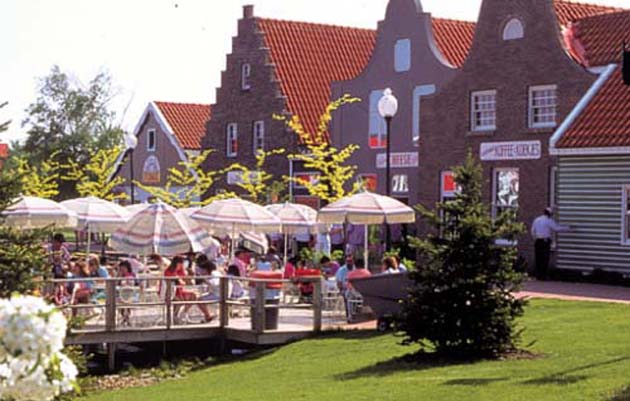
The next year, claver as the brothers were to offer drinks and Dutch specialty foods, while costumers could shop, an Old-Dutch styled café was added. Every time in off-season a new building or attraction was build, so the expansion of the Village became a touristical attraction overpassing local importance. And even more, a wholesale division in the 70's for imported Dutch goods distributing nationwide, while in the 90's by internet a mail order department did business expand internationally. For a drink or a snack The Hungry Dutchman café, welcomes all guests
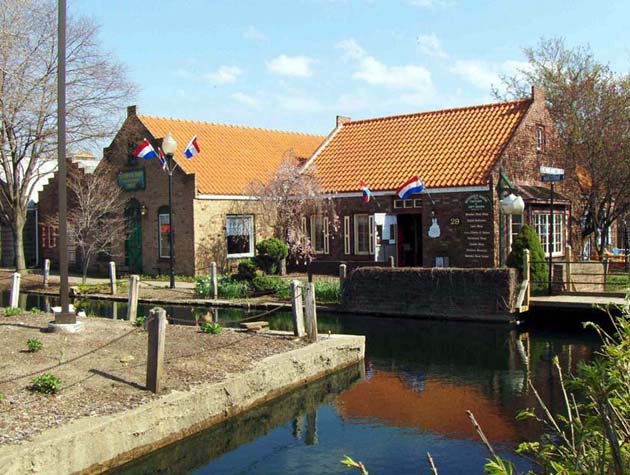
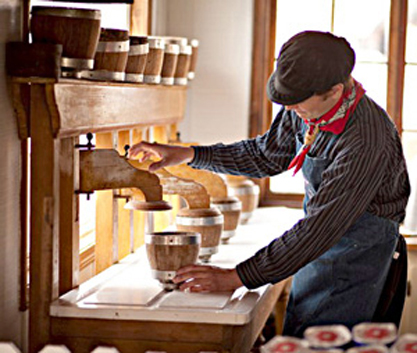
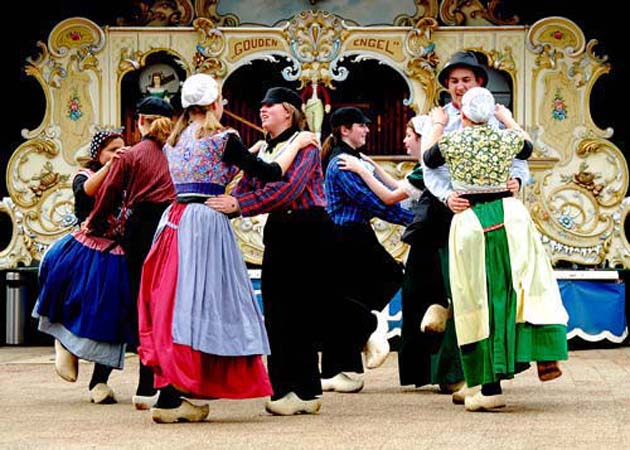
Currently there are more than 30 structures in the Dutch Village, with architecture representing different provinces of the Netherlands, mainly wellknown reproducted brickwork houses in style of Holland en Zeeland. Beside you will find workshops for making cheese, wooden shoes. Outlets for selling chocolate, candies, cookies and other Dutch food specialities, who are popular among American costumers. Street Organ De Gouden Engel (The Golden Angel)
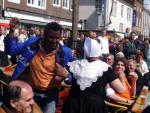
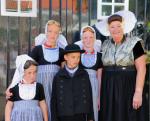
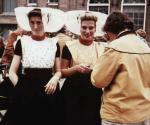
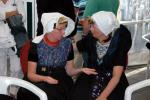
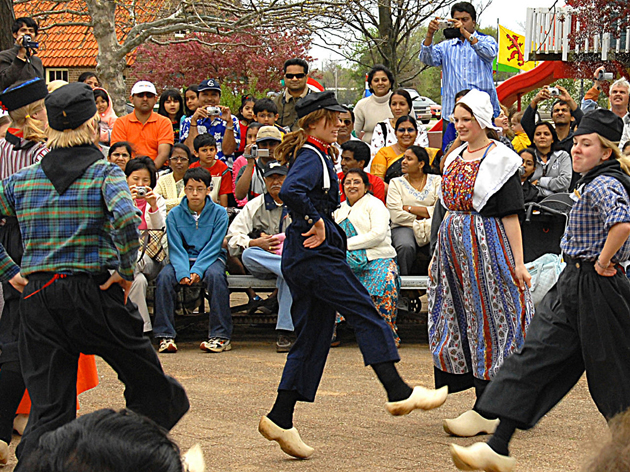
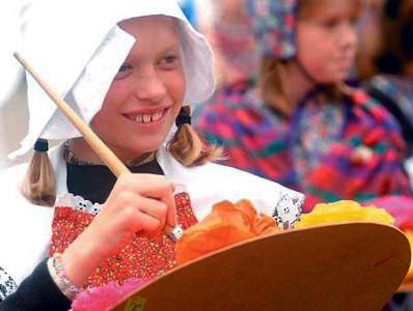
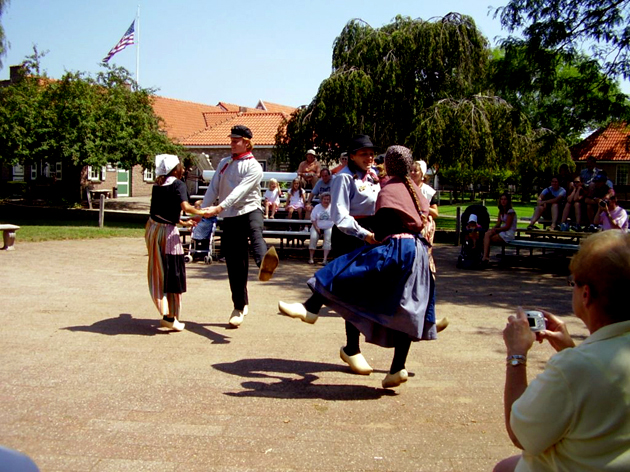
Never a dull moment in the park. Dancing groups perform Old Dutch dances in costumes of different regions of the Netherlands. Each province and even a part of it, have by tradition or history a variation of dresses. Women are most colourfull dressed with beautyfull garments, which are difficult to obtain today, because these fabrics are made by a very small number of manufacters. The Wooden shoe dance as an attraction (Klompendans)
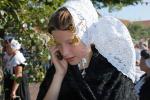
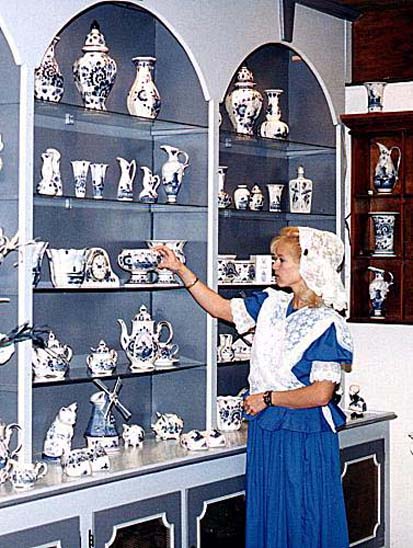
The costumes are never ready-made to buy, women make their clothes themselves, complicated in form and sewing methods. By jewelry or special forms of caps you can see, weither the woman is a member of a protestant or catholic church, or she is married or might be still available for engagement. When a close member of the family dies, the women wears a mourningdress, all in black. Even her jewelry is mimimized to a black necklace. The period of mourning last for the loss of a father or mother at least one year. For others in the family is a half years of mourning, normally the standard. In one of the souvenirshop you can buy original Delft Blue, always a gadget
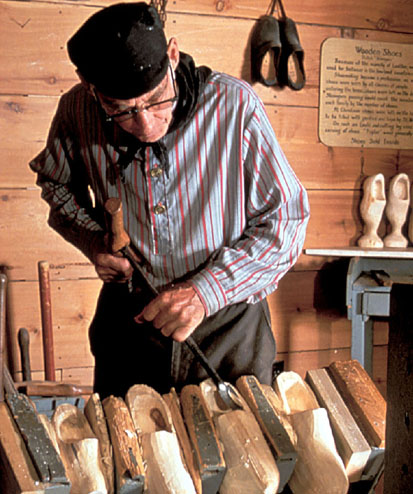
A day at the park is for children always fun. At the mini-farm they can ride a pony, there is a interactive workshop, a cinema, children rides, an Ice cream parlour, street organs specially imported from Holland, where you can enjoy the sound of a complete mechanical orchestra. The fairytail of Pieter who saved Holland for floods by holding his finger into the dyke, is a never missing item for tourists. Making wooden shoe's by hand is hard and specialised artcraft
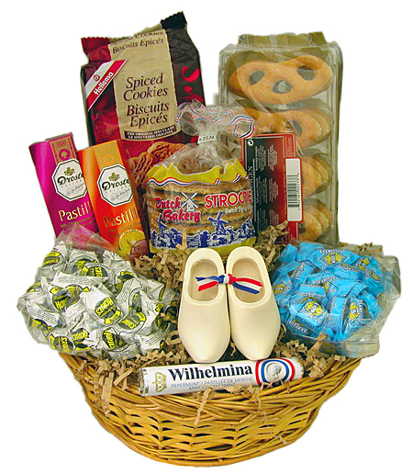
The times I travelled to America, no greater pleasure I could present my friends by bringing chocolate, pepermunt, stroopwafels, or Zeeuwse boterbabbelaars. Sigars are nowadays out of favour, though the quality is superb. A piece of Delft blue opens doors where you wouldn't expect. It's nice to give a welcome gift to a friend. Typical Dutch candies and cookies, popular all over the world.
Every country is wellknown by its speciality; Belgium by all kinds of high quality beer, of which is spoken as it is a delicate sort of wine, what's truly right. Germany is recognized by beer also, but even so by "Frankfurter Wurst," and "Schwartzwalder drindln," though its a stereotyped image, just as pizza belongs to Italians and croissant-bread to the France, what's not true.
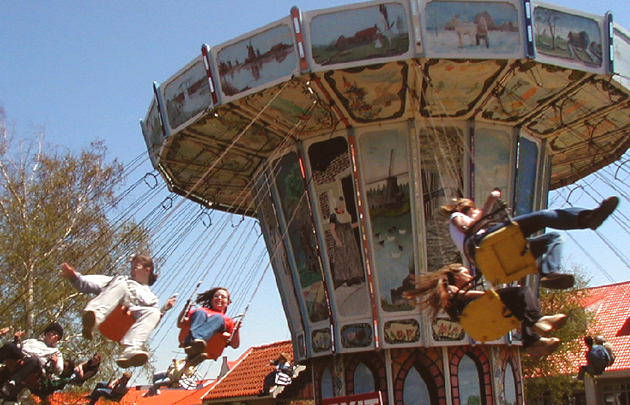
And the Dutch's? What do they like the most....?.... Everything that can be sold!! Trade marks as Droste Pastilles, Heineken Beer, Hopjes, Delft Blue or Tulip Bulbs are worldwide associated with Holland. At the shop of Nelis you will find all those Dutch delicious quality food stuff. Do you feel home-sick? Help yourself to cure of it, go to Nelis. A real Dutch Swing Ride, specially imported from Holland
Kermis, or Funfair in English, is by origin an annual-mass on devotionday of the patron of a village or city. Kermis is a degenaration of the word "Kerkmis or Kerke-misse." On that day, people flocked together to devote the saint patron in proccession to the church, afterwards finding amusement at the marketplace. Still, there is a connection with this religious festival and a procession in small villages. From that time on, all kinds of pleasure was offered by the "spullenbaas, or foorkramer," respectively called in Dutch and Flamish. A "Draaimolen, a Zweefcaroussel, a Bootschommel," childern spent all there saved money on a thrilling ride. Bagging grantmothers, fathers, mothers and aunts for more "centjes." Children's interactive workshop
Holland is a city in the western region of the Lower Peninsula of the U.S. State of Michigan. It is situated near the eastern shore of Lake Michigan on Lake Macatawa, which is fed by the Macatawa River. Holland was settled in 1847 by Dutch Calvinist separatists, under the leadership of Dr. Albertus van Raalte, who were escaping from persecution in the Netherlands for their opposition to scientific and social advances (e.g. contraseption, vaccination, insurance, chemical fertilizers) in their homeland.
In Holland's early history, van Raalte was a spiritual leader, as well as overseeing political, educational and financial matters. In 1847 Van Raalte established a congregation of the Reformed Church in America, which would later be called the First Reformed Church of Holland. Holland City Michigan in ancient times
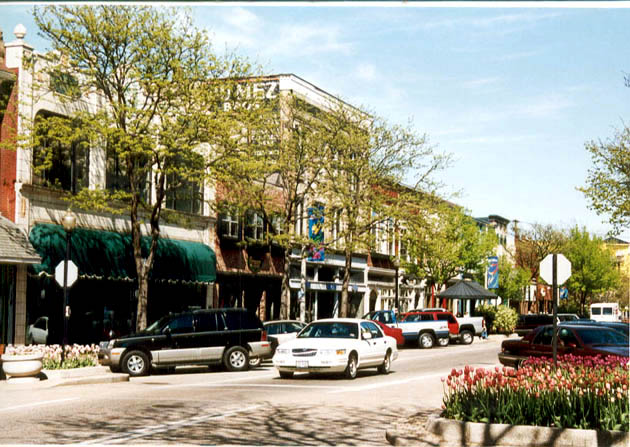
The city is perhaps best known for its Dutch heritage, which serves not only as a part of the city's cultural identity, but the local economy as well; the Tulip Time Festival in May and various Dutch-themed attractions augment the nearby Lake Michigan shoreline in attracting thousands of tourists annualy.
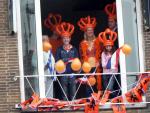
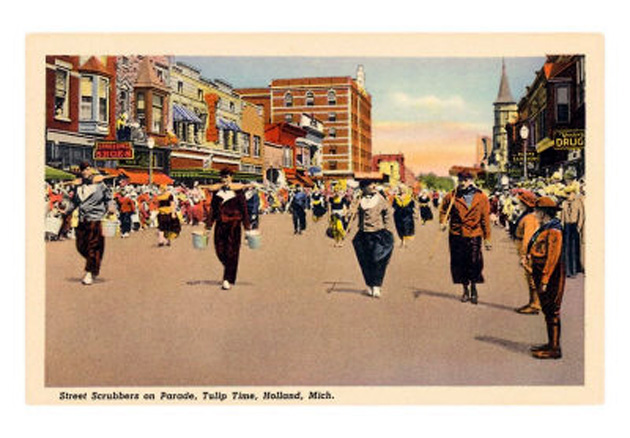
About one million tourists visit Tulip Time Festival each year, for which the community finds innovative ways to enhance self-funded projects. It has been ranked as America's third largest town festival and was named Readers' Digest's best small town festival. The Tulip Time Festival has attracted big name acts in recent years such as; Christina Aguilera in 2000, O-town in 2001, The Verve Pipe, with Holland born, lead-singer Brian vander Ark in 2003, and Jars of Clay in 2006. Ed McMahon vistted Tulip Time in 2007 along with Bobby Vinton. Tulips Time festival since 80 years an annual streetparade, (Volkparade, Muziekparade, Kinderparade)
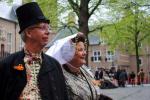
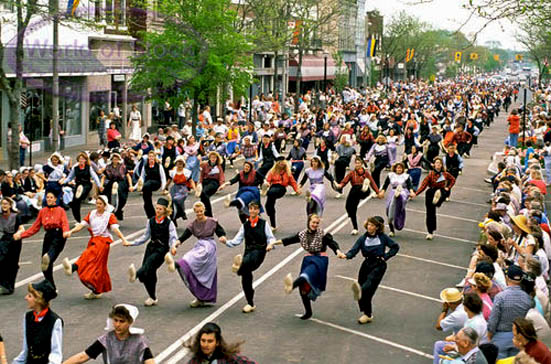
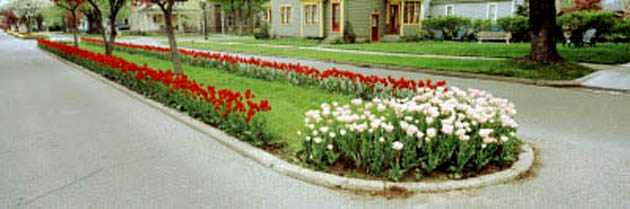
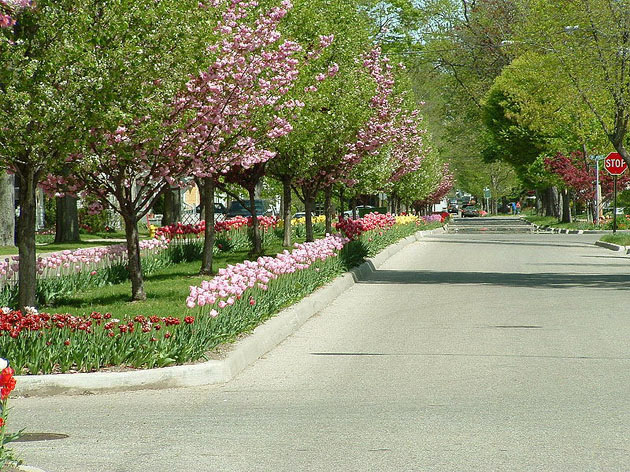
Since 1929, the small city of Holland has blossomed with literally hundreds of thousands of tulips. Like most celebrations, the Tulip Festival started as a relatively small event, which was proposed by Miss Lida Rogers, a high school biology theacher. In 1927, Miss Rogers presented the idea of commemorating Holland's Dutch heritage, history and culture to the Women's Liberary Club. Her proposal was accepted, and in 1929, the City of Holland planted its first crop of 100.000 tulips. The overwhelming number of visitors to our small town resulted in the community's decision to repeat the event. A vivid tradition of streetparade in Old Dutch costumes, over 1300 Dutch Dancers
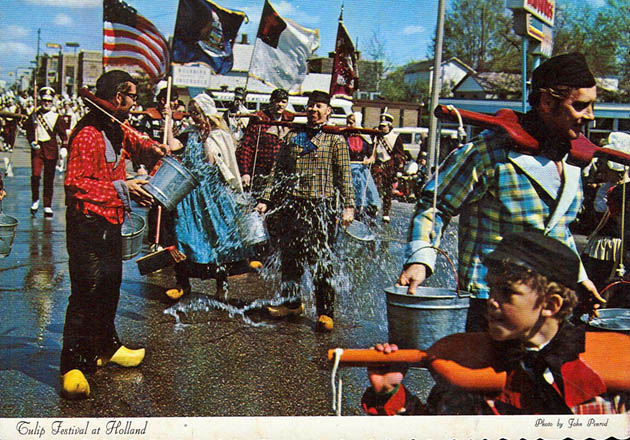
As thousands of spectators soared to hunderds of thousands, the celibration lenghtened by days, and pageantry, costumes and parades and the popular Dutch Dancers were added to produce a week-long festival that is now over 80 years old. Visitors to the Tulip Time festival are invited to take some tulips home, in paper form. It's not allowed by city ordinance to pick live tulips from the parks. Folkloristic streetsrcubbbers for ones in a year
The history of Dutch Dance began in 1935 with local high school girls performing at the Tulip Time Festival. They were dressed in costumes and were called "Klompen Dancers." The precursor to these Dancers began 2 years earlier when a high school gym teacher Ethel Perry trained twelve students to perform Dutch Folk dances. The Dancers, then called the "Dutch Villagers," performed to the tune of "When, Oh Where, Has My Little Dog Gone?" but did not perform as part of the Festival. Originally the dancers' costumes were Delft blue with white organdy caps and aprons. The Michigan way of klompendans (wooden shoe dance)
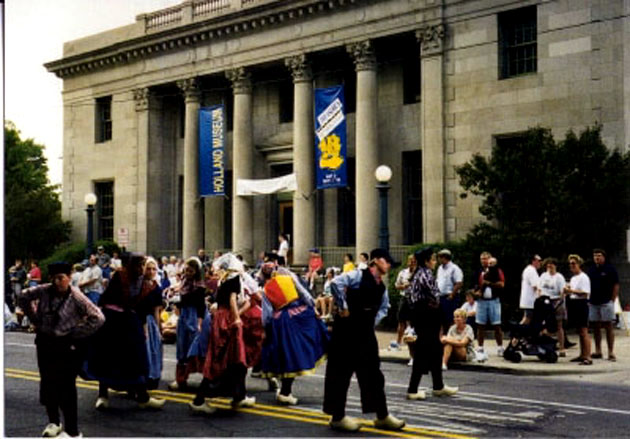
In 1953 a compilation of Dutch Folk music was created. Dutch Dance as we know it was choreographed and standards for costumes were developed. Over the years, as information became available, additional costumes were added and revisions were made. Today's Dancers wear costumes patterned after the traditional dress of the Dutch Provinces. Each costume is handmade by local seamstresses and carefully inspected before it can be worn in the Dutch Dance performances. There are currently over 1300 Dutch Dancers. The "klompendans" in a new fashion way in front of Holland Museum
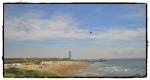
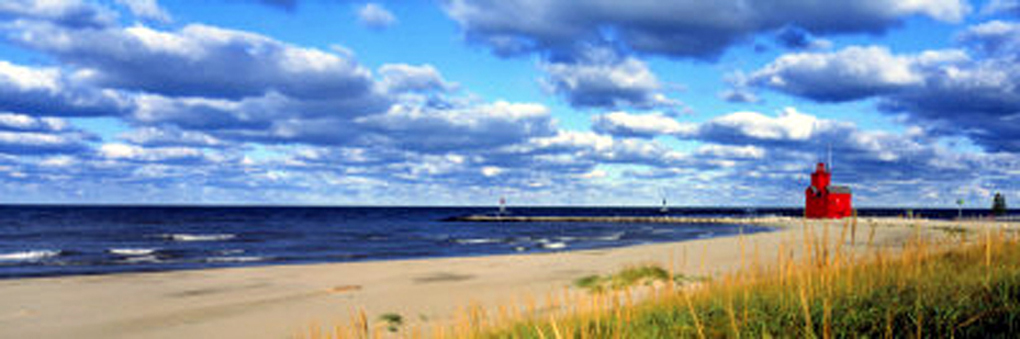
Many Dutchmen left the Low Countries at the Northsee for a successful future elsewhere in the world, in course of time. It happened in all centuries. You will find Dutch familynames in Brazil, Argentina, South-Africa of course, in Australia, Canada and non of the least in America. In particuraly in the State of Michigan, Dutch immigrants estabished a settlement in 1847 as they called it Holland. It was Rev. Dr. A. C. van Raalte of Ommen, a small village of the province Overijssel in the Netherlands, with his Dutch Calvinist followers who found a place of free worship near Lake Macatawa. They felt at home easely, the landscape, rivers, the high sky with impressive coulds, reminded them to their homeland. Beach of Lake Macatawa with the Big Red Lighthouse
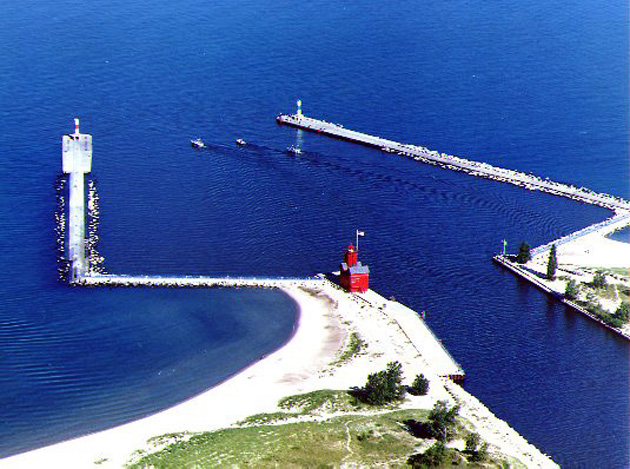
In years following, Holland developed to an agglomerate of villages with names remembering the descent of citizens like; Harlem, New Holland, Noordeloos, Zutphen, Vriesland, Drenthe, Overisel, Graafschap, Groningen and Zeeland. It's not difficult to guess at where they came from. Many from the province of Noord-Holland, famous for tulipfields. Others came from the eastern part of the Netherlands or from Zeeland. The province of a gathering of islands and sub-islands, shaped by overfloods during centuries, rich of history, people who have been sailing all over the world, leaving their marks back in language, such as Jersey Dutch. Aerial view of Port Holland Michigan
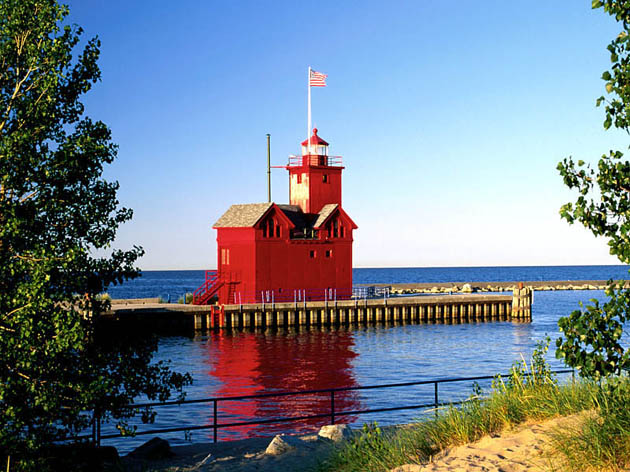
Nowadays most people of Holland don't speak Dutch anymore, nevertheless some words remain. The typical Dutch soup called "snert" is known as pea-soup, after the old-fashion recipe it will taste as it should be. Expressions like "it's benauwd" will sound familiar when the weather is moisty or clammy. Even the police serves surprisingly under the aphorism; "God zy met ons," and "Eendragt maakt magt." The historic Big Red Lighthouse of Holland Michigan
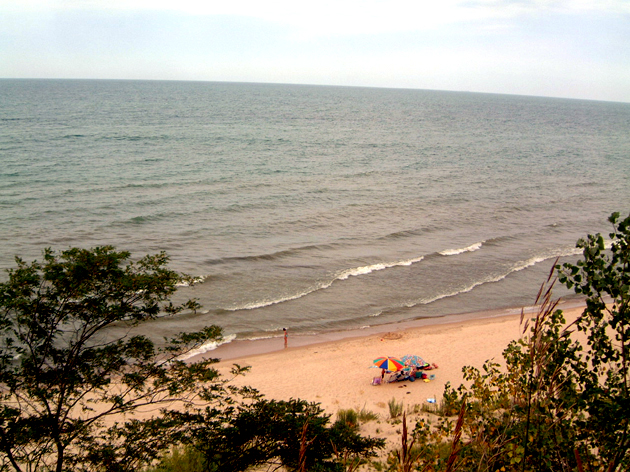
Holland is not a harbour for fishingboats anymore. The Lighthouse is out off order, though it's still a remarkeble landmark, modern navigation systems has taken over the secure guidance for privateboats. A committee is been formed to restore the lighthouse and to replace the 100 years old French reflecting lamp. When you want to see more about this wonderful building click on http://vimeo.com Item Big Red. Lonely at the beach on a sunny day
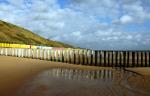
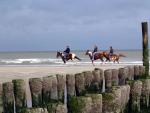
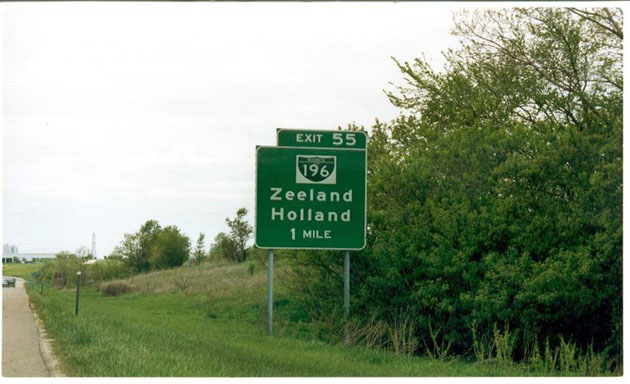
Never a crowded place on the beach, who would'nt like to have a whole beach for themselfs. A luxery for big-city people. After 1 mile many Dutchman feeling home at this exit
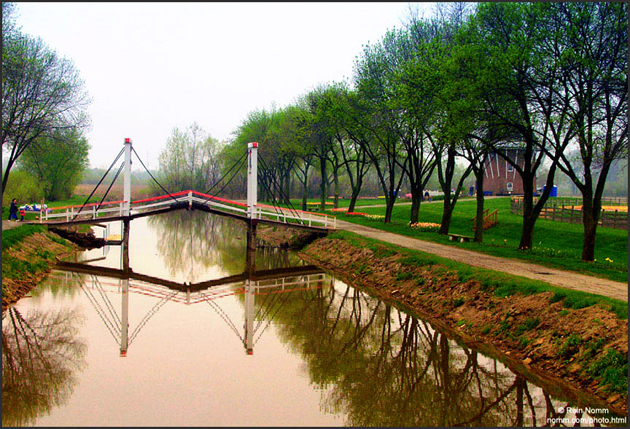
Neeltje Klercq and her husband Cornelis Jacobus Doorn took the decision to leave Den Helder for a future in America. Presumably they knew relatives or friends in the new country. At those times there were economic and political worries in Europe. Social life was diplorable, labor hard to find, the economy was in decline. Den Helder was a marineplace, with an economic mono-culture, life perspective was not prosperious. Den Helder, situated up country of Noord-Holland, would never grow out to a thriving city. All together the decision was easy to make. Is this Holland Michigan? It even could be the tulipfields near Amsterdam
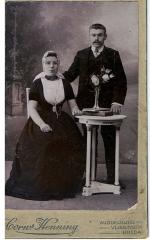
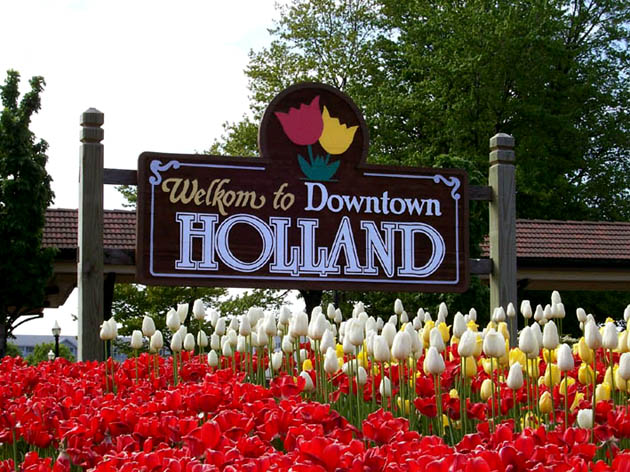
Neeltje, born 19 jan. 1882 Den Helder, was the youngest daugther of Jacobus Anthonie Klercq and his wife Maayke van der Dusse. Father was born in Middelburg, Zeeland. Mother's background laid back in Overschie, near Rotterdam. Ten children were born out of this marriage, only Neeltje left her father and mother. She would never see them again. It was a struggle to herself as well for her father, who was plagued by many troubles in his life. His first wife, Maria Donk died soon after his marriage, as wel as their first born son after two weeks. Mother and child were buried in the same grave in The Hague. Jacobus was inconsolable. Where else grow tulips the best? (Remark; Welcome is written in Dutch !!)
Father Jacobus Anthonie Klercq was a most faithfull "dominee" of the Christian Reformed Church, after his study at The Hague he ministered churches in Bruinisse, Zuid Beyerland, Den Helder and Huizen. He was a socialy concerned clergyman who established together with local officials a "School with the Bible" in Den Helder, the school still exist to this day. For many people he had a word of attention, his preaches were a comfort to a worried soul. Altruistic as he was, he helped people in needs. His dead was a long struggle of servere illness during more than two years, while a daughter nursed her father all that time, till his last breath. Of these last hours exist a dramatic report by an elderman of his church, written in beautyfull 19th century notation. Friendly Holland City in Springtime
The life of Neeltje and Cornelis Jacobus Doorn in Holland City is rather unkown to the family. Contact was lost after so many years. A new generation was born. They adapted a different way of life, descendants became American. The name of Klercq is vanished, only the Doorn's set on their name. On this blog you will find a complete view of the family of Jacobus Anthonie and his wife Maayke. (See Klercq Middelburg, left columm, scroll down to <De kinderen van de Dominee>.) Flower makes your day happy. (News) After an intensive and succesfull search after all, I found Neeltje and her husband Cornelis in the files of Ellis Island Records. Old papers open easely by the blessings of modern communication today. It must has been 26th of november 1910 when Neeltje and Cornelis shipped in on the ss Nieuw Amsterdam, a Holland-Amerika Line passengersvessel and set sail to New York with her first born child Jacob, where they arrived about 11 days later on the 5th of December 1910. On festivalday of St. Nicolaas, when children are spoid with small presents. For baby Jacob there where no presents, father had too little money with him. The $30,-- in his pocket was aimed for other purposes. Neeltje Klercq was at the time 29 years, her husband Cornelis Jacobus 27 years and little Jacob had just became 1 year old.
It was three years after their marriage, they came to the decision to immigrate to Amerika. Why they choose for Holland Michigan is unclear, non of the thirty immigrants, from Hungary, Austria, Russia, Holland and Germany, on board travelled further on to this region, so wellknown in The Netherlands. This arrival must have feld as a kind of coming home for this young couple full of plans and ideals. Its thanks to the records of the immigration board we now know how they looked like. A family in fair complexion, husband 182 cm tall, blond hair, brown eyes. Wife 172 cm tall, blond hair, blue eyes, the boy looked alike his father.
Cornelis Jacobus Doorn was a printer at the time, his mother Hendrikje Visser possessed the bookstore of her husband Jacob Doorn, who was a printer as well and publisher together in Huizen, an old city near the IJsselmeer not far from Amsterdam. Cornelis and Neeltje have lived for a short period in Naarden, because as we know son Jacob was born there. How Neeltje met Cornelis is not difficult to image. Father Jacobus Anthonie Klercq was pastor in Huizen at the Christian Reformed Church.
Here ends the story of Neeltje and Cornelis, after their departure from The Netherlands, nothing more came to the knowledge of the family in the homeland. Only the mourning card of Neeltje's father is telling us, that his beloved daughter was moved to the USA, what set me to this never lasting search. We don't know if there has been born more children, weither son Jacob has married, or descendants will still live in Holland Michigan. I won't be surprised, one of these days a Doorn pops-up on Facebook.
(News) There is news again, from the archive of Family Search this time. After Neeltje and Cornelis arrived in America, there aim was to find a job in Michigan, not without a reason they choose for Grand Rapids, Kent, because members of the Doorn-family moved before them to the United States in particulary to this area.
Two children are born after son Jacob. A sister Marie (P) Doorn born presumably on 16th of March 1916 in Grand Rapids, where she died at the repectable age of 91 years on the day of 31 january 2008. A year after the birth of Marie a brother joined the family, Henry Doorn he was called in 1917. Where he lived or died is not known untill now.
A city without flowers is a dull city
There is much more to tell about the Klercq-dynasty. The earliest Klercq found until now is Louwerens Klercq, born in 1711, Roosendaal, Noord Brabant. By four brothers the Klercq's spread out in the second generation to Dordrecht, Willemstad, Dinteloord, Roosendaal and Rotterdam. Surprising connections are found, for example in Dordrecht, the famous Dutch painter Johannes Vermeer is connected sidewise to the family. In New York (Nieuw Amsterdam) we discovered Alexander Klercq who married Femmetje van Borsum, he lived for many years at south side of Wallstreet, where the NYSE is build. Among his friends are early members of the Roosevelt family. (See story; A Klercq in New York)
Two clergymen are in the family; Jacobus Anthonie of Middelburg and Willem Klercq of Dinteloord, many more "dominee's" joined the family by marriages. One of the sons of Louwerens Klercq is Cornelis Klercq, a coppersmith and fire-enginemaker appointed in 1782 to the Abbey of Middelburg. Jacobus Anthonie is his grandson. In a way, more or less, most of the Klercq's are of Zeeland descent. Nelis' Dutch Village, a themed touristic park, at James street Holland
Kent u ze nog? De straatmuzikanten die van stad naar dorp, van kermis naar jaarmarkt trokken, best veel bekijks kregen maar slecht werden beloond. Ze speelden de sterren van de hemel, het mansenbakje kregen ze nauwelijks gevuld. De passanten keken snel de andere kant uit, wanneer een kleine bijdrage werd gevraagd voor de muzikale arbeid.
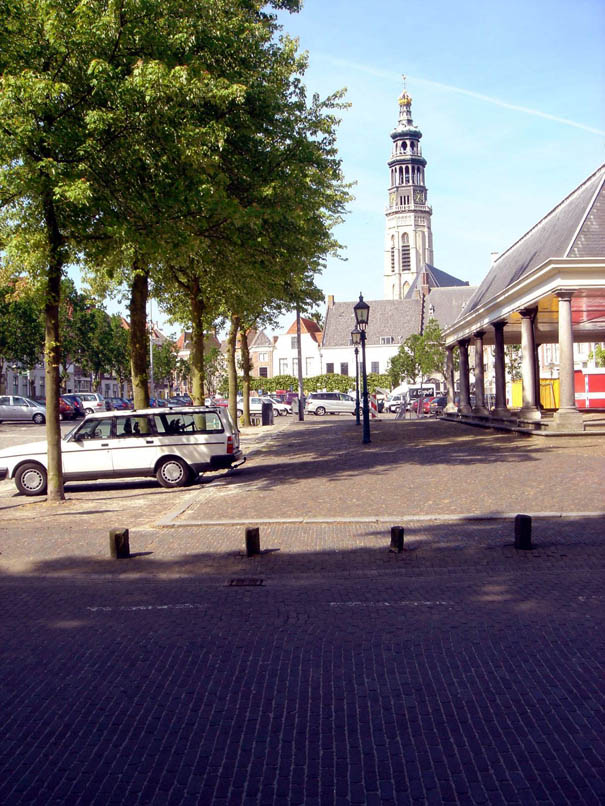
Vaak is de opvatting dat muzikanten "spelen." Moet je daarvoor betalen? Het werkwoord "spelen" geeft al aan dat er niet serieus gewerkt wordt, en toch is het arbeid. Zelfs met hart en ziel, want anders komt er niets van terecht. Mina van 't Urgel en Rinus Flohil uit Middelburg wisten wel beter. Het gesjouw met de Arabier, het zware straatdraaiorgel dat nog op de echte manier werd bespeeld, zoals het hoort. Dus het orgel met de hand draaien, wat al een kunst op zich is omdat het tempo exact gelijk moet zijn. En niet zoals tegenwoordig een luidruchtig benzinemotortje de hele sfeer verpest. Het Nieuwe Damplein in Middelburg met de Lange Jan.
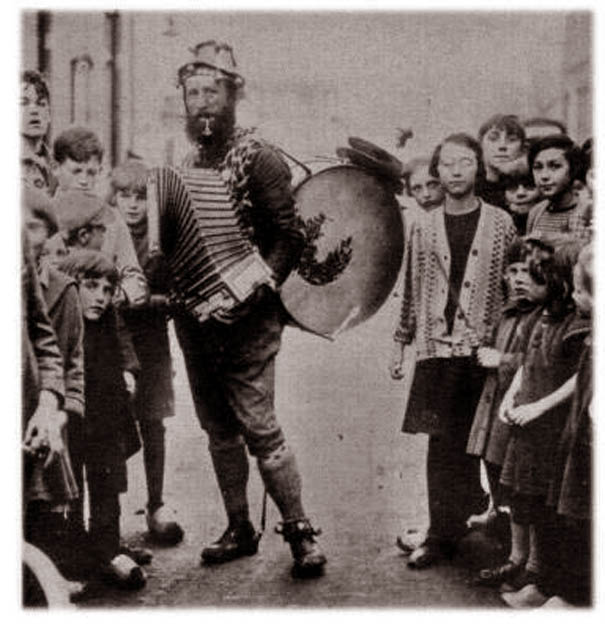
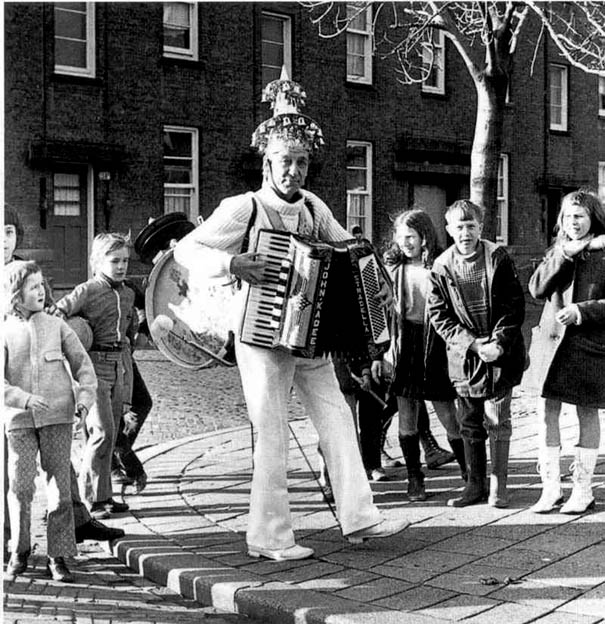
Straatmuzikanten zijn zo oud als de middeleeuwen. Koperen Ko is voor Nederland één van de bekendste geworden, omdat hij door het hele land trok. Hij had het vak van zijn vader geleerd. Vader Wilhelm Leiendecker kwam uit Duitsland, later vestigde hij zich in Nederland. Zijn zoon Johannes Willem Leiendecker volgde hem letterlijk in zijn voetsporen op. Net als zijn vader vormde hij in zijn ééntje een éénmansorkest, zoiets was nog zelden vertoond. Minstens drie tot vier instrumenten tegelijk bespelen gaf een ware sensatie, speciaal bij kinderen die dan ook te hoop liepen wanneer Koperen Ko in de straat verscheen.
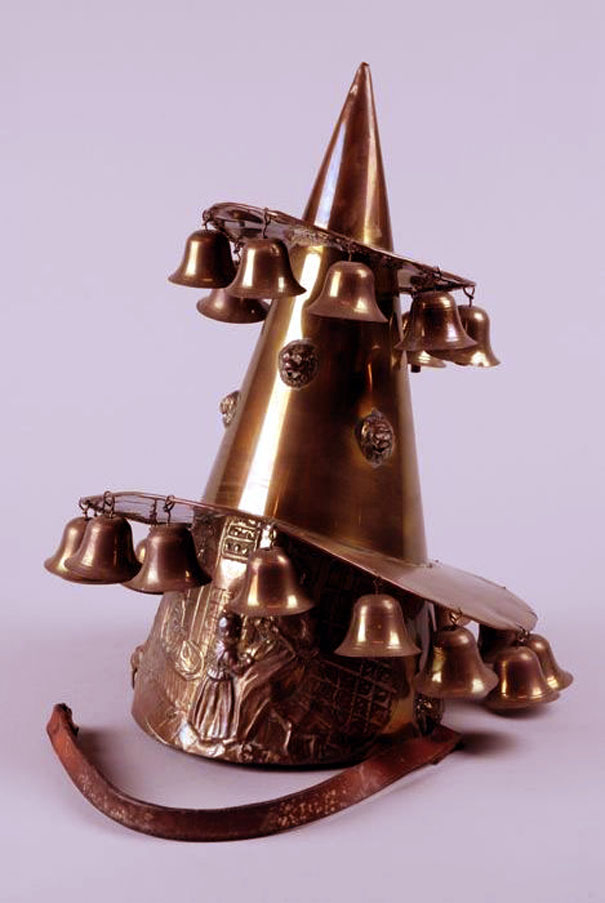
Snel rende ik naar huis om een paar dubbeltjes te halen. Soms gaf dat een scène, mijn moeder kon het geld wel beter gebruiken, zei ze. Waarop ik aan mijn spaarpotje rammelde, in de hoop dat op tijd wat muntjes eruit rolden. Op een holletje rende ik Koperen Ko achterna. Hij was er niet de man naar, die op een paar centen stond te wachten, waardig liep hij al spelend verder. Hijgend deed ik mijn centjes in zijn bakje. Een genadig knikje kon er net vanaf, nog meer schudden met zijn hoofd zou zijn koperen bellenpuntmuts doen klinken, en dat was nu ook weer niet de bedoeling. Vader Wilhelm Leiendecker speelde ver voor de oorlog in Duitsland (Die Lustige Tiroler)
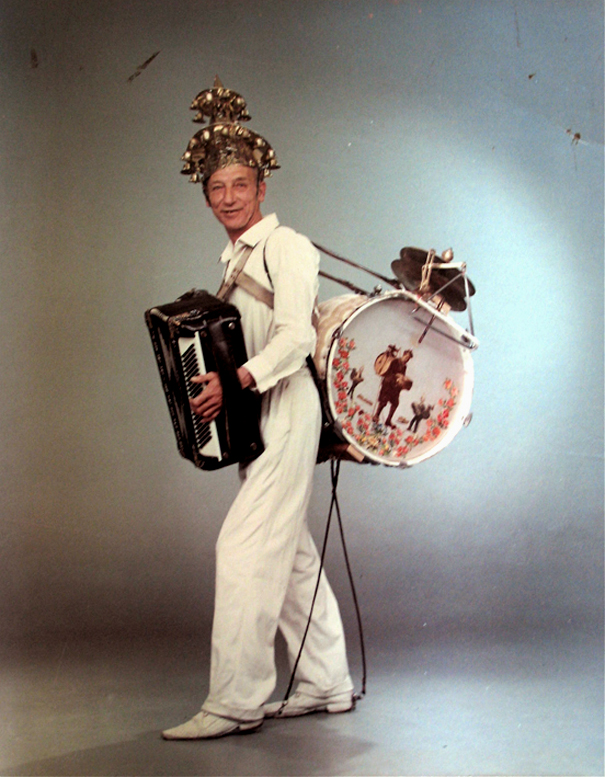
Koperen Ko is legendarisch geworden door de creatie van Nikkelen Nelis door Wim Sonneveld, met het liedje "Zij kon het lonken niet laten." De creatie heeft Johan nooit erg bevallen, en nog minder het liedje. Hij was van mening dat het "lonken" op zijn vrouw Martha sloeg, die aan een oogziekte leed waardoor ze ongewild voortdurend met haar ogen knipperde. De beroemde staatiefoto van Johannes Willem Leiendecker, alias Koperen Ko. (1909-1982)
Het bleek een toevallige samenloop te zijn. Friso Wiegersma, die het liedje had geschreven, wist niets van dat mankement af. Bovendien besloot Wim Sonneveld pas veel later zich uit te dossen als Nikkelen Nelis. Het heeft Koperen Ko alleen nog meer populariteit bezorgd, maar ook schimpscheuten bij zijn latere optredens. Na schrale inkomsten in al die jaren daarvoor, ging het hem daarna beter voor de wind.
Na het overlijden van zijn vrouw Martha is hij uit Middelburg naar Rotterdam verhuisd, waar je hem geregeld op de Lijnbaan al muciserend kon aantreffen. Vanaf zijn 13de jaar is Koperen Ko zijn musikantenvak 55 jaar lang trouw gebleven. In Oosterhout is hij op 18 april 1982, op 73-jarige leeftijd overleden. Daarmee is een einde gekomen aan drie generaties straatmuzikanten. Zijn zonen hebben hem nooit opgevolgd. Het straatmusikantenvak veranderde van stijl, amateurs en gelegenheid spelers probeerden een graantje mee te pikken. De koperen bellenpuntmuts wordt nu bewaard in een Rotterdams streekmuseum.
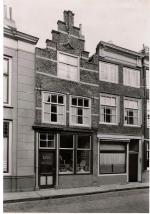
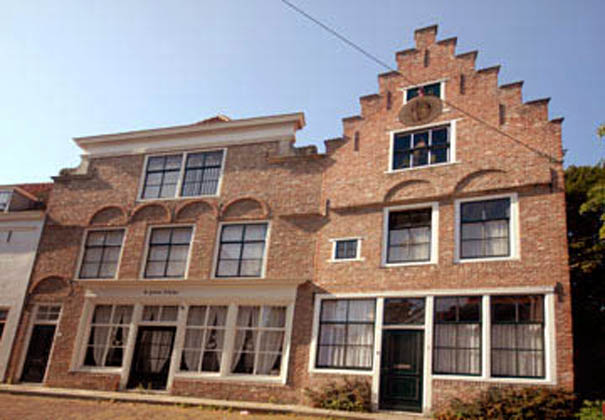
Nooit zal meer een Koperen Ko door de straten musiceren. Zo uniek als Johan was, kan geen ander zijn plaats innemen. Zijn koperen muts wordt niet meer gepoetst. De Lange Jan weerspiegeld nooit meer op zijn glanzende muts, de belletjes zullen niet meer vrolijk klinken. Zijn accordeon is stilgevallen, zijn dikke trom ligt te verstoffen. Bedankt Koperen Ko, je was uniek. Het rechter huis is bewoond geweest door de familie Leiendecker, het is een herdenkingsplaquette waard.
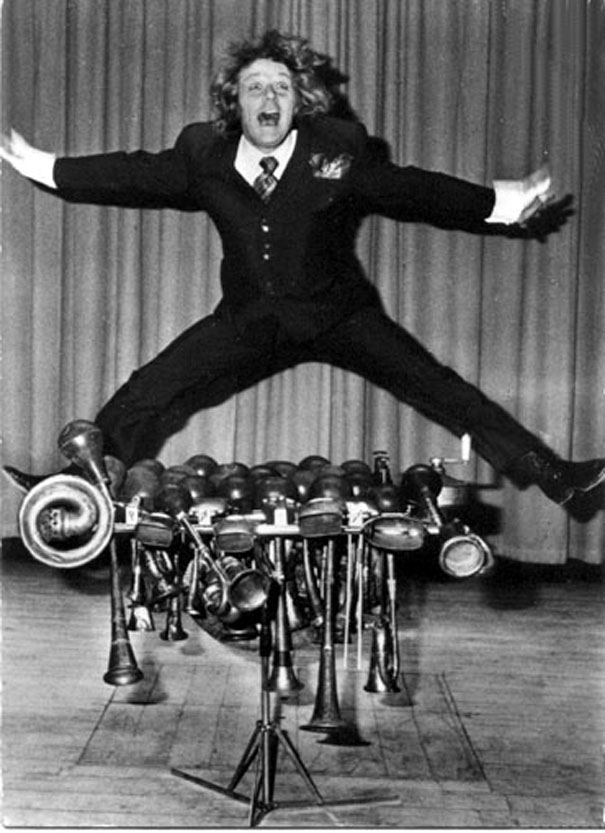
Koperen Ko woonde lange tijd met zijn vrouw Martha in Middelburg, niet ver van ons huis in de Bellinkstraat in een groot huis, wat wel nodig was want hij had een heel stel kinderen. In de jaren '50 en '60 was het een wat onderkomen straatje, met her en der onbewoonbaar verklaarde woningen, terwijl die toch bewoond werden. De straat stond op de nominatie gesloopt of gerestaureerd te worden. Het is gelukkig niet tot sloop gekomen. Nu zijn alle huizen in die straat voorbeeldig gerestaureerd. Ook het huis van Koperen Ko is voor verval gespaard gebleven. Toby Rix met zijn toeterix
Op de schnabbeltoer bezochten veel varieté artiesten ook Middelburg. Ze werden welwillend aangehoord, hoe zeer ze ook hun best deden het publiek te vermaken, niemand werd daar merkbaar enthousiast van. Of het nu van radio en televisie bekende Coctail Trio was, de Wama's of Toby Rix, in een feesttent of op de Markt kwam er wel nieuwsgierig volk op af, toch bleef het publiek soïstijns luisteren. Een koud applausje kon er nog net vanaf. Je kon het op de gezichten aflezen; "Doe maar gewoon, ons zul je zo gek niet krijgen."
Radeloos werden de artiesten hiervan, net als de standwerkers op de Donderdagse Marktdag. Ik heb een standwerker zijn tong binnen een uur zien verslijten bij de aanprijzen van "wonderpannen" waarbij hij met een vogelfluitje in zijn mond de omstanders probeerde te verleiden. Al zijn getjilp, het nadoen van parende vinken, tot jubelend gekwetter van een parkiet, zelfs met al zijn acteertalent waren zijn toehoorders niet enthousiast te krijgen. Laat staan de portemonee te trekken voor een unieke éénmalige aanbieding die het leven van moeder-de-vrouw zo zorgeloos kon maken.
Verbijsterd heb ik die man zich zien omdraaien, de handdoek in de ring gooien, kwaad weglopen naar het dichtbijzijnde cafë, nog net van hem te horen; "Die stomme Zeeuwen, er is geen cent aan te verdienen." Even zo verdwaasd liep het volk uiteen, met de gedachte "Het zal wel. Ik geloof er niks van, volgens mij worden we bedonderd door die Hollander." Toby Rix nog steeds envogue, nu internationaal beroemd.
Toby Rix heb ik ook zien verdwijnen van het podium. De Toeterix eenzaam achterlatend, na een serie toppers te hebben gespeeld, zoals; "Als een heer in het verkeer, Mijn vader is een mooie...., of Malle Vent Ja." Het publiek stond erbij en keek er naar....., niet vroóólijk te krijgen. Moedeloos liet hij zijn toeschouwers bedremmeld achter. Ze wisten ook niet wat ze met die guitigheid moesten aanvangen. Het Coctail Trio en de Wama's hadden dezelfde ervaring. De Middelburgers waren nog niet bevrijd van een knellend keurslijf. De verlossing zou pas vele jaren later komen, na de roerige jaren '60. Koperen Ko, zoals we hem allemaal kennen.
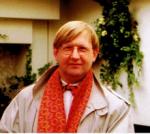
Ik ben Albert Prins
Ik ben een man en woon in Geleen (Nederland) en mijn beroep is gep. Interieur Architekt.
Ik ben geboren op 06/02/1946 en ben nu dus 79 jaar jong.
Mijn hobby's zijn: Genealogie, Writing. Art Basketmaking.
Write or Call me; 00-31-(0)46-4740641














 Ik ben Albert Prins